Gold Seamless Tiling Patterns Set 2: A Practical Evaluation for Designers and Makers
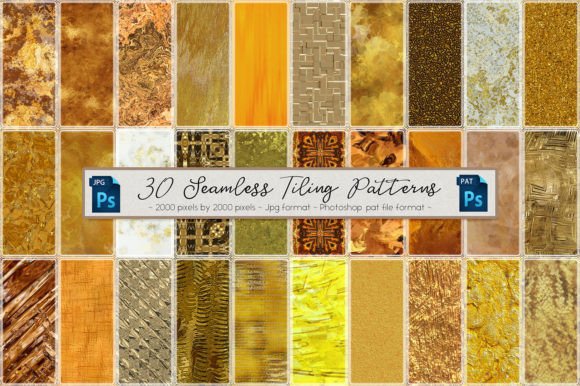
Gold Seamless Tiling Patterns Set 2 is a curated collection of 300 distinct, high-resolution seamless patterns—each designed with metallic gold tones, subtle texture variation, and consistent tiling behavior. Unlike single-pattern downloads or generically styled gold repeats, this set emphasizes visual diversity across motifs: geometric lattices, organic florals, Art Deco flourishes, minimalist linework, and abstract gradients—all unified by a cohesive gold palette and professional-grade technical execution.
What Makes This Set Distinct Beyond the Basics
The technical specifications are foundational but meaningful: every pattern arrives as a 2000 × 2000 pixel JPG at 300 DPI, ensuring crisp output for both screen-based interfaces and physical print applications up to poster size. Equally important is the inclusion of a Photoshop .pat file—a time-saving asset for designers who frequently apply patterns directly in Adobe Photoshop layers, adjustment masks, or layer styles. This dual-format delivery bridges workflow gaps: the JPGs support universal compatibility (Illustrator, Affinity Designer, Canva, Cricut Design Space), while the .pat file streamlines repetitive use within Photoshop’s native ecosystem.
Crucially, “seamless” here isn’t just marketing language—it reflects tested tiling behavior. Each pattern was manually verified to eliminate visible seams, ghosting, or alignment artifacts when repeated across large canvases or tiled across fabric layouts. That reliability matters most in medium-to-large-scale projects: think wall murals spanning multiple panels, custom textile yardage for apparel production, or full-page backgrounds in editorial layouts where repetition must feel intentional—not accidental.
Fitting Into Broader Pattern Ecosystems
When evaluating Gold Seamless Tiling Patterns Set 2 alongside other pattern resources, three dimensions stand out: format flexibility, stylistic range, and scalability.
- Format flexibility: Many free or low-cost gold pattern packs offer only one format—often a small PNG or low-res JPEG. Others deliver vector files (.ai or .svg), which excel for scaling but lack the nuanced grain, halftone texture, or metallic sheen that raster formats preserve at 300 DPI. Gold Seamless Tiling Patterns Set 2 avoids that tradeoff by prioritizing raster fidelity *and* including a working .pat file—giving users control over how and where they deploy each pattern.
- Stylistic range: Some gold-themed collections lean heavily into ornate Baroque or vintage script motifs, limiting their adaptability across modern branding, packaging, or UI design. In contrast, Set 2 balances tradition and minimalism—roughly 40% of the patterns are clean, low-contrast repeats suitable for subtle watermarking or luxury stationery; another 35% feature bolder geometry ideal for fashion textiles or product packaging; the remainder explore tonal gradation and micro-texture for digital overlays or printed wallpaper.
- Scalability: At 2000 × 2000 pixels, these files scale well to A3 or 16×20" prints without interpolation. But they’re not infinite-resolution vectors—so for applications requiring extreme enlargement (e.g., building wraps or stadium banners), users may need to pair them with vector-based gold foil textures or consult a print specialist about optimal tiling density.
Real-World Use Cases and Practical Tradeoffs
Designers selecting Gold Seamless Tiling Patterns Set 2 often do so for specific project types where consistency, tone, and production readiness matter more than maximal customization.
For print-based paper crafting, the 300 DPI resolution supports fine-detail die-cutting, foil stamping mockups, and letterpress test runs. Users report success printing on metallic cardstock, kraft paper, and textured cotton rag—especially when adjusting ink opacity in RIP software to preserve gold’s luminosity. However, because all patterns are pre-rendered in RGB, CMYK conversion requires careful soft-proofing; gold hues may shift slightly depending on substrate and press calibration.
In fashion and textile design, the set works well for surface pattern development—particularly for scarves, lining fabrics, or limited-run apparel. The 2000-pixel tile size allows for realistic repeat simulation at common fabric widths (e.g., 54" or 140 cm), and the variety helps avoid visual fatigue across garment panels. That said, textile mills often require patterns at specific DPI or repeat dimensions (e.g., 12" × 12" at 150 DPI). While resizing is possible, heavy interpolation can soften fine lines—so users planning large-batch production should verify tile dimensions against mill requirements before finalizing layouts.
For digital interfaces and branding, the patterns serve reliably as subtle background elements in presentations, email headers, or web banners. Their gold tone adds sophistication without overwhelming readability—especially when layered with 10–20% opacity over solid color backgrounds. Yet unlike CSS-generated gradients or SVG filters, these are static images. That means no dynamic responsiveness (e.g., adapting to dark mode) and no real-time parameter adjustments. If interactivity or theme-switching is essential, a hybrid approach—using these patterns as base textures and overlaying dynamic elements—often yields stronger results.
When Gold Seamless Tiling Patterns Set 2 Fits—and When It Doesn’t
This set excels when you need a dependable, diverse, production-ready library of gold-toned repeats—and when your workflow benefits from both universal JPG access and Photoshop-native efficiency. It’s especially valuable for freelancers juggling multiple clients, in-house designers supporting seasonal campaigns, or makers producing small-batch physical goods where consistency and speed reduce revision cycles.
It may be less suitable if your work demands:
- Vector scalability for infinitely resizable logos or signage;
- Editable color palettes (e.g., switching gold to rose gold or antique brass without reworking each tile);
- Animated or interactive pattern behavior (e.g., parallax scrolling or hover-triggered texture shifts);
- Extensive cultural or historical motif specificity (e.g., authentic Japanese kamon, Islamic zellige, or West African adinkra symbols rendered in gold)—as Set 2 prioritizes broad aesthetic cohesion over niche cultural representation.
Also consider licensing scope: while the set permits commercial use—including resale on physical products like notebooks or apparel—the license does not extend to reselling the patterns themselves as standalone digital assets. That’s standard for most design resource packs, but worth verifying if your business model includes redistributing pattern libraries.
Making an Informed Choice
Before choosing Gold Seamless Tiling Patterns Set 2—or any pattern collection—ask two questions: What’s the primary output medium? and How much time do I have to adapt, test, and refine?
If your priority is getting polished, gold-accented visuals to market quickly—whether for a boutique clothing line, wedding invitation suite, or premium presentation deck—this set reduces friction. Its breadth minimizes the need to source multiple packs, and its technical consistency lowers the risk of last-minute tiling corrections.
But if your project hinges on precise color matching across devices and substrates, or if you regularly modify motifs at the component level (e.g., rotating, recoloring, or combining elements), then a vector-based gold pattern toolkit—or even creating custom repeats in Illustrator using gold swatches and pattern brushes—may offer greater long-term control.
Ultimately, Gold Seamless Tiling Patterns Set 2 occupies a practical middle ground: not the most flexible, not the most minimal, but reliably capable across common creative workflows. Its strength lies not in exclusivity, but in execution—300 thoughtfully varied, technically sound, gold-infused patterns, ready when you are.