Fox Tales Patterns Clipart: Seamless Forest Magic for Modern Creators
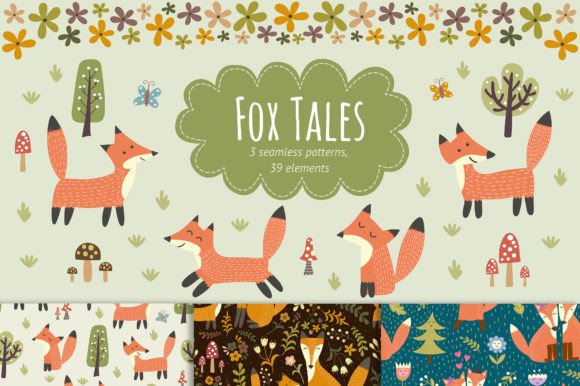
There’s something quietly powerful about a well-designed pattern—especially one that carries warmth, narrative, and intention. Fox Tales Patterns Clipart isn’t just another digital asset pack; it’s a small but meaningful response to how creators today value both aesthetic coherence and practical flexibility. Built around a forest theme with nine hand-drawn foxes and thirty delicate trees and plants, this collection reflects a growing shift in design preferences: toward gentle storytelling, nature-infused palettes, and assets that work across mediums without compromise.
Why Seamless Forest Patterns Are Gaining Quiet Momentum
Seamless patterns have long been essential in textile design, packaging, and web backgrounds—but what’s changed is *how* they’re used. Today’s professionals aren’t just applying patterns as decorative fill; they’re weaving them into brand identities, educational materials, product labels, and even print-on-demand merchandise. The rise of independent publishing, micro-businesses, and educator-led resource creation means more people need high-resolution, production-ready assets that don’t require advanced vector skills to adapt.
Fox Tales Patterns Clipart meets that need precisely. Its three seamless repeats—each delivered in AI, EPS10, JPEG (5556×5556 px, 400 dpi), and PNG (4167×4167 px, transparent background, 300 dpi)—are sized for real-world use: large-format printing, fabric sampling, or responsive web overlays. Unlike many clipart sets that prioritize quantity over cohesion, these patterns share a unified tone: soft outlines, balanced negative space, and a consistent scale between foxes and foliage. That consistency reduces decision fatigue—something busy freelancers and small-business owners report as a frequent bottleneck.
From Isolated Elements to Integrated Workflows
The 39 included elements—nine foxes and thirty botanicals—aren’t scattered across separate files. They’re thoughtfully grouped: all isolated in one AI/EPS10 file, plus individual PNGs with transparent backgrounds at 300 dpi. This structure supports multiple workflows. A surface pattern designer might extract and rearrange foxes within the seamless tile. A teacher creating printable forest-themed classroom posters can drag-and-drop single foxes onto lesson slides without clipping or resizing hassles. A small-batch stationery maker can layer individual ferns behind handwritten quotes, adjusting opacity and blend modes freely.
This level of modularity reflects how creative software has evolved—not just in capability, but in expectation. Users no longer want “flat” clipart they must trace or rework. They want clean, scalable vectors and crisp raster files ready for immediate integration. And because every element was drawn by hand—not generated or traced—the set carries subtle variation: slight differences in ear tilt, tail curl, leaf shape. That human touch matters. It helps avoid the uncanny flatness of AI-generated motifs, especially in markets where authenticity and craftsmanship are quietly becoming differentiators.
Aesthetic Alignment with Contemporary Lifestyle and Brand Values
Look closely at current visual trends in wellness branding, indie publishing, and sustainable product design—and you’ll see recurring motifs: muted earth tones, organic linework, gentle animal symbolism. Foxes, in particular, appear with increasing frequency—not as cartoon mascots, but as quiet emblems of curiosity, adaptability, and quiet intelligence. They resonate in ways that feel grounded, not gimmicky.
Fox Tales Patterns Clipart leans into that resonance without overstatement. The foxes aren’t anthropomorphized with speech bubbles or exaggerated expressions. They’re simply *there*: peeking from behind birch trunks, curled beneath mossy stones, mid-step among ferns. That restraint makes the set unusually versatile. It works equally well for a children’s nature journal, a boutique apothecary’s label, or a mindfulness app’s onboarding screen—because it doesn’t impose a mood; it invites one.
Practical Use Cases Across Professions
Real-world application is where this set reveals its depth. Consider these examples:
- Educators use the isolated foxes and plants to build custom flashcards, seasonal bulletin board displays, or illustrated reading comprehension worksheets—no licensing ambiguity, no pixelation when printed double-size.
- Freelance designers integrate the seamless patterns into client presentations for eco-friendly packaging concepts, embedding them directly into mockups to show texture and rhythm before final production.
- Small business owners print the patterns on fabric for limited-run tote bags or tea towels—knowing the 400 dpi JPEGs meet printer specifications for sharp repeat alignment.
- Bloggers and content creators apply the PNGs as subtle watermarks or corner accents in Canva templates, maintaining brand continuity across newsletters, social posts, and downloadable lead magnets.
None of these uses require specialized training. The files open cleanly in Adobe Illustrator, Affinity Designer, Procreate (with import), or even Figma (via SVG conversion). That accessibility lowers the barrier—not just for seasoned designers, but for educators building their first digital resource library or makers launching their first Etsy shop.
What “Made With Love” Actually Means in Practice
The phrase “made with love” appears in the description—not as marketing fluff, but as a functional indicator. Hand-drawn assets carry inherent qualities that algorithmically generated ones often lack: intentional line weight shifts, natural asymmetry, and spatial relationships that feel considered rather than calculated. You can see it in how the foxes nestle into the composition—not centered, not uniform, but arranged with the quiet logic of actual forest dwellers.
That intention translates into usability. For instance, the spacing between trees allows for easy cropping if you need a narrower repeat for a phone wallpaper or narrow web banner. The foxes’ proportions hold up whether scaled down to 12 pt for embroidery digitizing or enlarged for a wall mural. And because all vector files are EPS10 and AI-compatible, users retain full editability—changing colors, adjusting anchor points, or combining elements without quality loss.
Looking Ahead: Pattern Design as Thoughtful Infrastructure
As digital tools become more accessible—and expectations for visual polish rise across industries—the role of pattern design is shifting. It’s no longer just about decoration. It’s about infrastructure: reusable, reliable, emotionally resonant building blocks that help creators communicate clearly, stand out authentically, and ship work faster.
Fox Tales Patterns Clipart fits neatly into that future—not as a trend-chasing novelty, but as a carefully constructed tool. It acknowledges that time is the most valuable resource for today’s professionals. By delivering resolution-appropriate files, intuitive organization, and cohesive aesthetics in one package, it removes friction rather than adding it. That’s not just convenience. It’s respect—for the creator’s process, their audience’s attention, and the quiet joy of drawing foxes, again and again, with care.