6 Kids Patterns: A Practical Guide for Designers and Educators
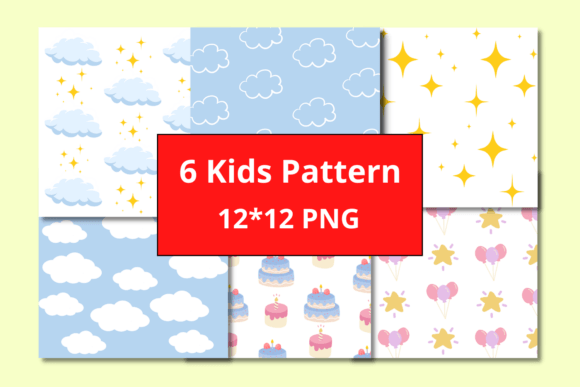
“6 Kids Patterns” refers to a set of six distinct, reusable visual design templates commonly used in educational materials, children’s activity sheets, classroom resources, and printable learning tools. These patterns are typically distributed as digital assets—often in PNG format—with consistent sizing (e.g., Size 12) and standardized dimensions (e.g., “12 Format PNG”) to ensure clarity and scalability across devices and print outputs. While the name suggests a fixed count and structure, the value lies not in the number alone, but in how thoughtfully each pattern supports developmental learning goals, visual consistency, and practical reuse.
Why People Explore 6 Kids Patterns
Designers, teachers, homeschooling parents, and curriculum developers often seek out 6 Kids Patterns when they need reliable, age-appropriate visual frameworks for early learning activities. Common use cases include creating matching games, sequencing exercises, sorting tasks, flashcards, and visual schedules. The interest stems from a need to balance pedagogical soundness with production efficiency—especially when time or design expertise is limited. Because young children respond well to repetition, rhythm, and clear visual cues, a small, curated set of patterns can offer more utility than a large, inconsistent library.
Benefits of Using 6 Kids Patterns
Working with a defined set like 6 Kids Patterns offers several practical advantages:
- Predictability and consistency: With only six variations, users can build familiarity—both in design execution and in how children interact with the materials over time.
- Ease of adaptation: Each pattern is typically provided in a transparent-background PNG at Size 12, making it straightforward to layer onto worksheets, digital slides, or interactive apps without distortion.
- Print and screen compatibility: The “12 Format PNG” designation often signals a resolution and aspect ratio optimized for legibility at common educational print sizes (e.g., A4 or letter) and on tablets used in classrooms.
- Reduced cognitive load for creators: Choosing from six intentional options helps avoid decision fatigue during lesson planning or resource development.
Tradeoffs and Realistic Expectations
While 6 Kids Patterns provides clarity and focus, it also introduces constraints that merit consideration. A set limited to six patterns may lack the thematic range needed for diverse topics—such as seasonal units, cultural studies, or advanced STEM concepts—without supplemental visuals. Users should expect to combine these patterns with text, photographs, or original illustrations rather than rely on them as standalone content.
Additionally, “Size 12” does not universally indicate font size or physical dimension—it usually reflects an internal naming convention tied to the asset’s pixel density or grid alignment. Users should verify actual dimensions (e.g., 300×300 px or 600×600 px) and DPI before high-resolution printing. Without embedded metadata or documentation, assumptions about scale or intended usage can lead to formatting issues.
When 6 Kids Patterns Is a Strong Fit
This resource works best in contexts where simplicity, repetition, and visual scaffolding support learning objectives. For example:
- Early childhood classrooms: Teachers building routine-based visual aids—like daily schedule cards or emotion charts—benefit from consistent shapes, colors, and spacing across all six patterns.
- Digital learning platforms: Developers integrating lightweight, scalable icons into drag-and-drop activities find the PNG format and uniform sizing reduce integration overhead.
- Small-scale curriculum development: Independent educators designing targeted skill-builders (e.g., phonics sorting or shape recognition) appreciate having a cohesive visual language without licensing complexity.
- Time-constrained projects: When deadlines limit iteration cycles, starting from six proven patterns accelerates prototyping and testing.
When Alternatives May Be More Suitable
6 Kids Patterns may not meet needs in scenarios requiring greater flexibility or specificity. Consider alternatives if:
- You need subject-specific iconography—such as anatomy diagrams, historical timelines, or scientific symbols—that falls outside the scope of generic developmental patterns.
- Your audience includes children with diverse sensory or cognitive profiles, and requires customizable contrast levels, alternative textures, or augmentative communication symbols (e.g., PCS or ARASAAC).
- You’re developing materials for multilingual settings and require culturally responsive imagery—not just stylistic variation.
- Your project demands vector-based assets (e.g., SVG) for infinite scalability or animation, and the available 6 Kids Patterns are raster-only PNGs without source files.
Making a Practical Decision
To determine whether 6 Kids Patterns aligns with your goals, begin by listing your core requirements—not just what you want the resource to do, but how it will be used in practice. Ask yourself:
- Will six distinct visual structures support the variety of tasks I plan to create—or will I need to supplement frequently?
- Do the provided PNG files match my technical needs (e.g., transparency, resolution, color mode)?
- Is consistency across materials more valuable than novelty or thematic richness for my learners?
- Are there accessibility considerations—such as color contrast ratios or screen reader compatibility—that this set addresses or overlooks?
If most answers point toward structure, efficiency, and developmental appropriateness, 6 Kids Patterns is likely a functional foundation. If your priorities center on adaptability, inclusivity, or domain-specific accuracy, evaluate whether the set can serve as one component among others—or whether a broader or more specialized resource better serves your purpose.
Final Considerations for Evaluation
When reviewing any set labeled “6 Kids Patterns 6 Kids Patterns 6 Kids Patterns Size 12 12 Format PNG,” look beyond repetition in the title. That phrasing often reflects file-naming conventions used in digital marketplaces or internal asset management—not a feature. Instead, inspect sample files for clean edges, consistent stroke weights, balanced negative space, and appropriate visual weight for small hands and emerging eyesight.
Also consider licensing terms. Some versions allow unrestricted classroom use; others prohibit redistribution or digital resale. Clarify permissions before embedding into shared platforms or published curricula.
Ultimately, 6 Kids Patterns is not a universal solution—but a deliberate tool. Its usefulness emerges not from quantity or branding, but from how well its constraints match your instructional intent, production capacity, and learner needs. As with any educational material, the strongest choice is the one that supports clarity, engagement, and growth—without adding unnecessary complexity.